Why Hip Position Matters, Part 3: Asymmetrical Pelvic Tilt

So far, we’ve looked at the pelvis as though both sides move together.
Tilt backward. Tilt forward.
Real bodies aren’t usually that tidy.
The pelvis is made up of multiple bones and joints, and the right and left sides don’t necessarily organize themselves the same way. One side can become biased differently than the other, creating an asymmetrical starting position that changes the relationship between the pelvis, sacrum, spine, and femurs.
This is where pelvic mechanics start getting considerably more interesting.
Understanding Asymmetrical Pelvic Tilt
Anterior and posterior pelvic tilt don’t always happen evenly on both sides.
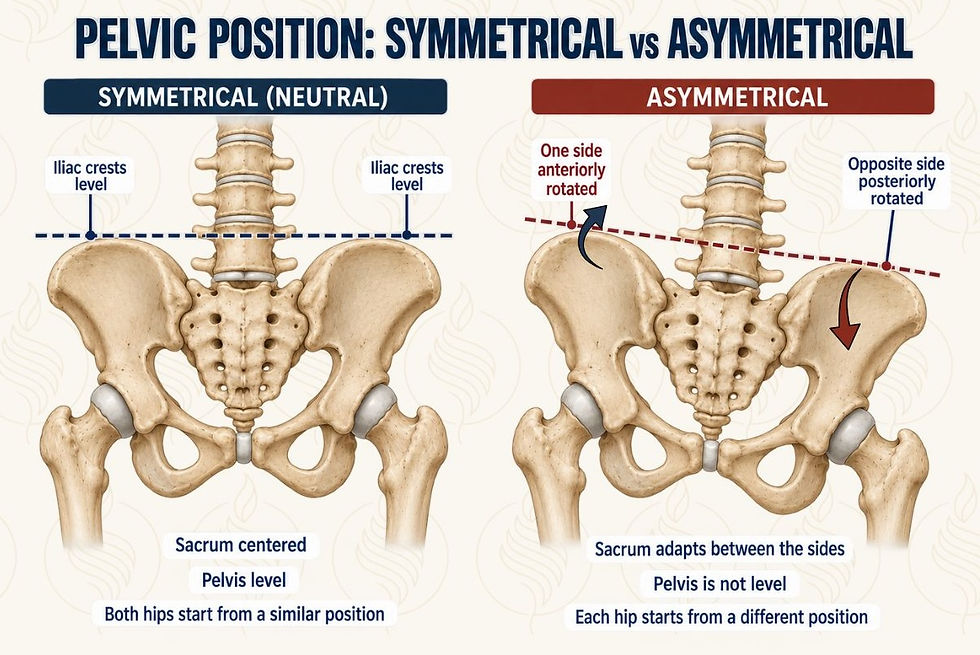
One side of the pelvis may sit relatively more anteriorly tilted while the other sits relatively more posteriorly tilted. The pelvis can also hike, drop, and rotate, meaning asymmetry rarely exists neatly in just one plane.
When the two sides of the pelvis sit differently, the structures attached to them no longer begin from identical positions. The right and left hip sockets may have different orientations, the femurs may move differently within those sockets, and even the sacrum sitting between the two sides has to accommodate that asymmetry.
When those positions become chronically biased, the body once again adapts around its new starting point.
But this time, the starting point isn’t just tilted.
It’s asymmetrical.
What Happens to the Sacrum?
The sacrum sits between the right and left sides of the pelvis, forming the sacroiliac, or SI, joints on either side. When those two sides are positioned differently, the sacrum has to accommodate the asymmetry between them.
Imagine one side of the pelvis sitting relatively more anteriorly tilted while the other sits relatively more posteriorly tilted. As the relationship between the two sides changes, the sacrum can become angled between them, with the tailbone shifting toward the more anteriorly positioned side and away from the more posteriorly positioned side.
That change in sacral position also changes how the SI joints are loaded. On the more posteriorly positioned side, the sacrum and pelvis may be pressed more firmly together at portions of the SI joint. On the more anteriorly positioned side, there may be less pressure between the same portions of the SI joint.
This doesn’t automatically mean the SI joint is damaged or that the sacrum is “out of place.” Some asymmetry is normal, and the sacrum should be able to move and adapt along with the pelvis. The concern is when muscular adaptations make that asymmetrical position chronic, repeatedly loading the two sides differently and making movement away from that position more difficult.
How Asymmetry Changes the Hips
Now things get particularly interesting at the hip sockets.
Remember that the acetabulum is part of the pelvis. When the pelvis changes position, the hip socket changes position with it.
With a symmetrical anterior or posterior tilt, both hip sockets change orientation together. With an asymmetrical pelvis, however, each socket may begin from a different orientation relative to its femur. If one side of the pelvis is more anteriorly tilted, that hip socket becomes oriented more downward and forward. If the other side is more posteriorly tilted, that socket becomes oriented more upward and backward.
This means the right and left hips may have different movement available to them. One hip may have more room in a particular direction while the other has less, simply because they are starting from different positions.
One hip may rotate more easily in one direction. One side may feel tighter during a squat. One leg may move differently during walking or running. The body may shift toward one side or repeatedly choose one movement strategy over another.
What appears to be a difference in hip mobility may actually reflect the different positions from which each hip is starting.

The Effect on the Rest of the Kinetic Chain
The pelvis still sits at the crossroads between the upper and lower body.
But now the two sides of that crossroads aren’t starting from the same place.
Below the pelvis, differences in hip position can influence how forces travel through each leg. Because the femurs connect the hips to the knees, asymmetrical mechanics at the pelvis and hips can continue down the kinetic chain, potentially changing how each knee, ankle, and foot manages movement and force.
Above the pelvis, the spine has to organize itself over an asymmetrical base. The lumbar spine and trunk may rotate, side-bend, or shift as the body works to remain upright and keep the head and eyes level.
The body can still accomplish the task, but it may require other joints and tissues to adapt around the asymmetry.
Over time, these compensations can show up in different places throughout the kinetic chain, including discomfort around one SI joint, unequal hip mobility, recurring tension on one side of the lower back, differences between the knees, or changes in how the ankles and feet move and manage force.
Again, none of these symptoms prove that pelvic asymmetry is their cause. They demonstrate why looking only at the place that hurts can give us an incomplete picture of the mechanics contributing to it.
The Bigger Picture
Across all three parts of this series, we’ve looked at three different presentations: posterior pelvic tilt, anterior pelvic tilt, and asymmetrical pelvic positioning.
But the lesson was never really about finding the “perfect” pelvic position.
It was about movement.
The pelvis should tilt forward and backward. It should rotate. It should hike and drop. The two sides should be capable of moving differently when the task requires it.
The position itself isn’t the problem. The problem begins when muscular adaptations make a position chronic and the body loses the ability to move freely away from it.
That’s why simply looking at someone’s posture and deciding that something needs to be “corrected” misses the bigger picture. The goal isn’t to force the pelvis into neutral and keep it there.
The goal is to give the body options.
The more movement options the body has available, the less it has to rely on the same patterns over and over again. Movement can be shared between the hips, pelvis, and spine instead of repeatedly being concentrated in the same place. The right side can move differently from the left when the task demands it. Force can be distributed throughout the kinetic chain instead of repeatedly being managed by the same joints and tissues.
That is the bigger picture behind all three pelvic positions we’ve explored. We aren’t trying to teach the body where to stay. We’re trying to restore its ability to go where it needs to go.
Healthy movement isn’t about holding yourself in one perfect position.
It’s having the freedom to move through many.
Want to Learn More
📖 Read this next: Why Hip Position Matters, Part 2: Anterior Pelvic Tilt
📍Book your free consultation to explore injury prevention, pain relief, and corrective exercise: Start here
Comments